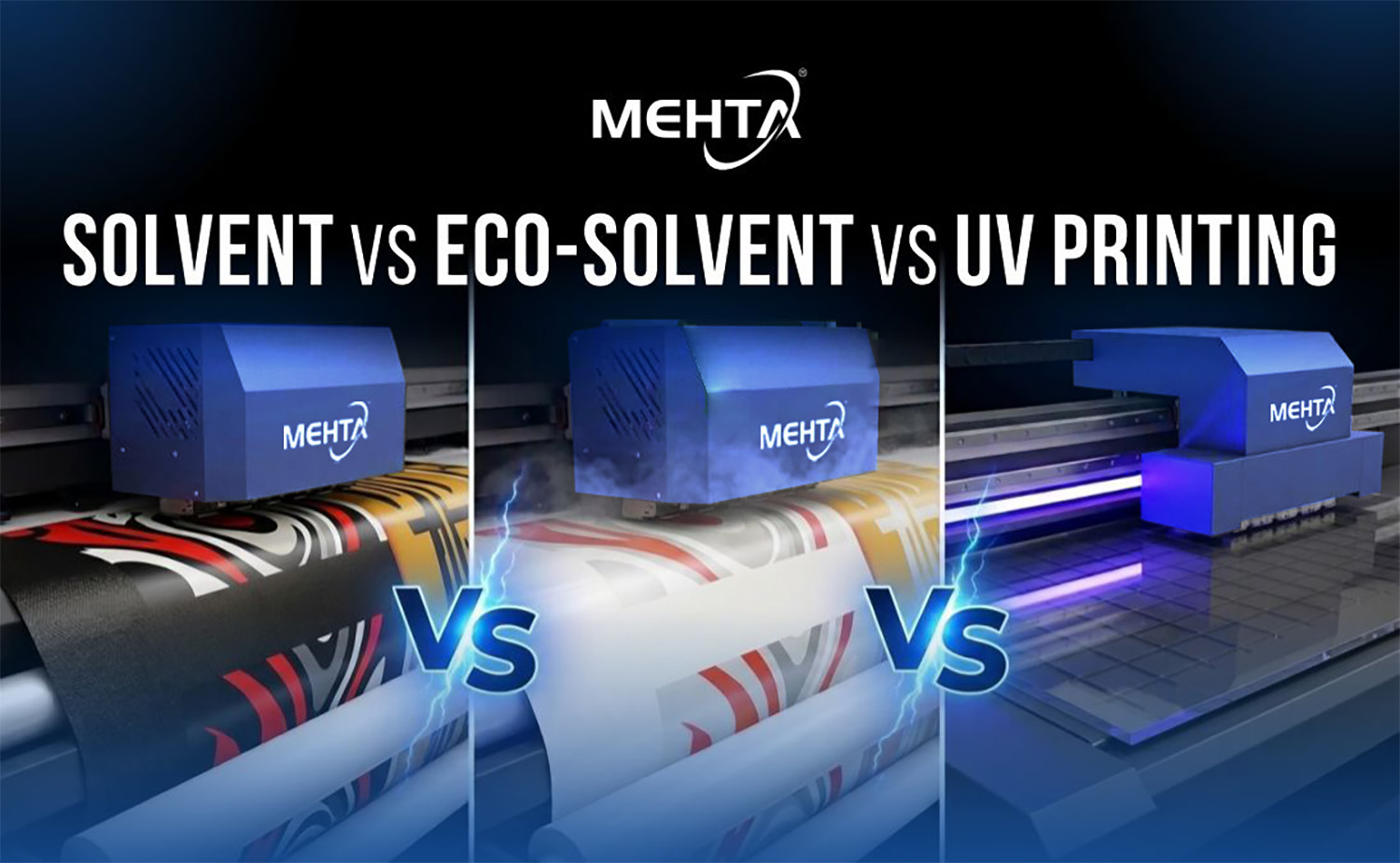
Choosing the right printing technology is one of the most important decisions a sign shop or large-format print business will make. Should you invest in a solvent printer, an eco solvent printer, or a uv printer? Each technology uses different ink chemistry and curing process, and each is suited to different substrates, production volumes, and working environments. In this guide, we break down solvent versus eco solvent printing versus uv printing so you can choose the right fit for your print shop.
Whether you’re researching uv printing near me, comparing an eco solvent printing machine against a traditional solvent printer machine, or exploring uv dtf printer options for stickers and transfers, this article covers the practical differences that matter for your bottom line.
Quick Comparison: Solvent vs Eco-Solvent vs UV Printing
| Feature | Solvent Printing | Eco-Solvent Printing | UV Printing |
| Ink Type | Strong solvent-based ink | Mild, low-odor solvent ink | UV-curable ink, cured instantly by UV light |
| Best For | High-volume outdoor banners, hoardings | Vinyl, banners, signage, indoor/outdoor graphics | Rigid & flexible substrates, short-run signage, décor |
| Odor & Ventilation | Strong odor, needs dedicated ventilation | Low odor, safer for indoor use | No solvent odor, ink cures instantly |
| Substrate Range | Mainly flexible roll media (vinyl, flex) | Flexible roll media (vinyl, banner, film) | Rigid and flexible: acrylic, wood, glass, vinyl, film |
| Print Speed | Very fast on large runs | Moderate to fast | Fast, with instant curing (no drying wait) |
| Running Cost | Lower ink cost, high-volume efficient | Slightly higher ink cost than solvent | Higher ink cost, but no separate drying step |
| Ideal Buyer | Large-format outdoor ad businesses | Sign shops wanting balance of cost & quality | Businesses needing versatility across rigid & flexible media |
What Is Solvent Printing?
Traditional solvent printing uses strong, chemical-based inks that bond directly into the surface of flexible roll media like vinyl and flex banners. A solvent printer machine is prized for its speed and durability, producing prints that hold up well outdoors for years which is why it remains the standard choice for high-volume hoardings, billboards, and outdoor advertising businesses.
Where Solvent Printing Excels
- Large-format outdoor banners, flex boards, and hoardings that need years of weather resistance
- High-volume production runs where speed and low ink cost per square foot matter most
- Businesses with dedicated, well-ventilated production space, since strong solvent inks require proper airflow
- Print shops already using a solvent printer and cutter setup for combined printing and finishing
What Is Eco-Solvent Printing?
An eco solvent printer uses a milder ink formulation than traditional solvent systems, producing far less odor while still delivering durable, vibrant output on vinyl, banners, and film. This makes an eco solvent printing machine one of the most popular choices for sign shops that need a balance between production quality and a safer indoor working environment.
Where Eco-Solvent Printing Excels
- Sign shops operating indoors or in mixed-use spaces where strong solvent odor isn’t practical
- Vinyl graphics, banners, vehicle decals, and window films that need good outdoor durability
- Businesses that want lower operating costs than UV printing while still avoiding the strong fumes of full solvent systems
- Growing print shops evaluating their first eco solvent printing machine as a step up from entry-level desktop printers
What Is UV Printing?
A uv printer cures ink instantly using UV light as it’s applied, rather than relying on the substrate to absorb solvent-based ink. This is what gives uv printing its biggest advantage: the ability to print directly on both rigid materials (acrylic, wood, glass, metal) and flexible roll media, often on the same machine. Buyers searching for uv printing near me or uv print near me are typically looking for this versatility.
Where UV Printing Excels
- Short-run, high-mix jobs across rigid and flexible substrates without swapping machines
- Signage, décor panels, and promotional items needing instant-cure, scratch-resistant prints
- Specialty applications like uv dtf sticker production, uv printing on acrylic, and direct-to-object printing
- Print shops that want to eliminate drying time and reduce solvent odor entirely from their production floor
Key Differences That Affect Your Decision
1. Working Environment and Ventilation
A traditional solvent printer needs dedicated ventilation due to strong ink odor, while an eco solvent printer is far more forgiving in mixed-use or indoor spaces. A uv printer produces virtually no solvent smell at all, since the ink cures instantly under UV light rather than off-gassing as it dries.
2. Substrate Versatility
Both solvent and eco-solvent systems are largely limited to flexible roll media. UV printing is the clear winner here, since a single uv printer machine can handle rigid substrates like acrylic and wood alongside flexible film a major advantage for shops with a varied order mix.
3. Production Speed and Cost
For high-volume, single-substrate production like continuous banner printing a solvent printer or eco solvent printing machine typically offers the lowest cost per square foot. UV printing carries a higher ink cost but eliminates drying time entirely, which can offset the difference for shops running many small, urgent jobs.
4. Output Durability
Solvent and eco-solvent prints are well-proven for long-term outdoor durability on vinyl and banners. UV prints offer excellent scratch and chemical resistance on rigid substrates, though outdoor flexible-media durability can vary depending on the ink and laminate used.
Which Should You Choose for Your Print Shop?
- Choose solvent printing if: You run high-volume outdoor banners and hoardings and have a dedicated, well-ventilated production space.
- Choose eco-solvent printing if: You want reliable vinyl and banner output with lower odor, suitable for indoor or mixed-use shops just starting to scale up.
- Choose UV printing if: Your orders span both rigid and flexible substrates, or you need fast turnaround without a drying wait ideal for signage, décor, and specialty items like uv dtf printer transfers and stickers.
- Consider a combination: Many established print shops eventually run more than one technology side by side to cover their full range of customer orders.
Final Thoughts
There’s no single uv printer or solvent printer that’s right for every print shop the best choice depends on your substrate mix, production volume, working environment, and budget. Solvent printing remains unbeatable for high-volume outdoor banner work, eco-solvent offers a safer middle ground for indoor sign shops, and UV printing delivers the versatility to handle rigid and flexible substrates on one machine.
Choosing the right manufacturer matters just as much as the technology itself. Mehta Hitech Industries Limited (formerly Mehta Cad Cam Systems) has over 25 years of manufacturing experience and offers all three printing technologies under one roof:
- For high-volume outdoor production, explore Mehta’s Solvent / Flex Printers, available with Seiko 1024HG and Epson T3200 printheads up to 3.2 mt print width.
- For a lower-odor, indoor-friendly option, explore Mehta’s Eco-Solvent Printers, including the Bruno and EVA series built on Epson i3200 printhead technology.
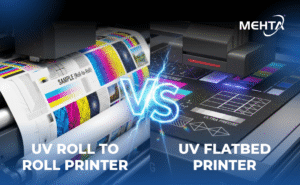
- For rigid and flexible substrate versatility, explore Mehta’s UV Flatbed Printers and UV Roll-to-Roll Printers.
With 15 ISO-certified manufacturing facilities, 17 sales and service offices across India, and machines showcased live at industry events like Media Expo 2026, Mehta India can help you choose the right printing technology for your exact production needs. Contact Mehta India today for a demo or a custom quote.
Frequently Asked Questions
Is eco-solvent ink safe for indoor use?
Eco-solvent ink produces significantly less odor than traditional solvent ink, making it suitable for most indoor and mixed-use print shops, though reasonable ventilation is still recommended.
Can a UV printer replace both solvent and eco-solvent printers?
A UV printer offers more substrate versatility, but high-volume outdoor banner producers often still prefer solvent or eco-solvent systems for their lower cost per square foot on large continuous runs.
Which printing technology lasts longest outdoors?
Solvent and eco-solvent prints have a long, proven track record for outdoor durability on vinyl and banners, while UV print durability on flexible outdoor media depends on the specific ink and laminate used.
What’s the difference between UV printing and UV DTF printing?
Standard UV printing applies ink directly to the final substrate, while UV DTF (direct-to-film) printing creates a transferable sticker or decal that can be applied to a wide range of surfaces afterward.
Call: +91 75750 09654
Email: mktg@mehtaindia.com
Disclaimer: The information provided in this blog, including all content and materials of any kind, is intended for informational purposes only.