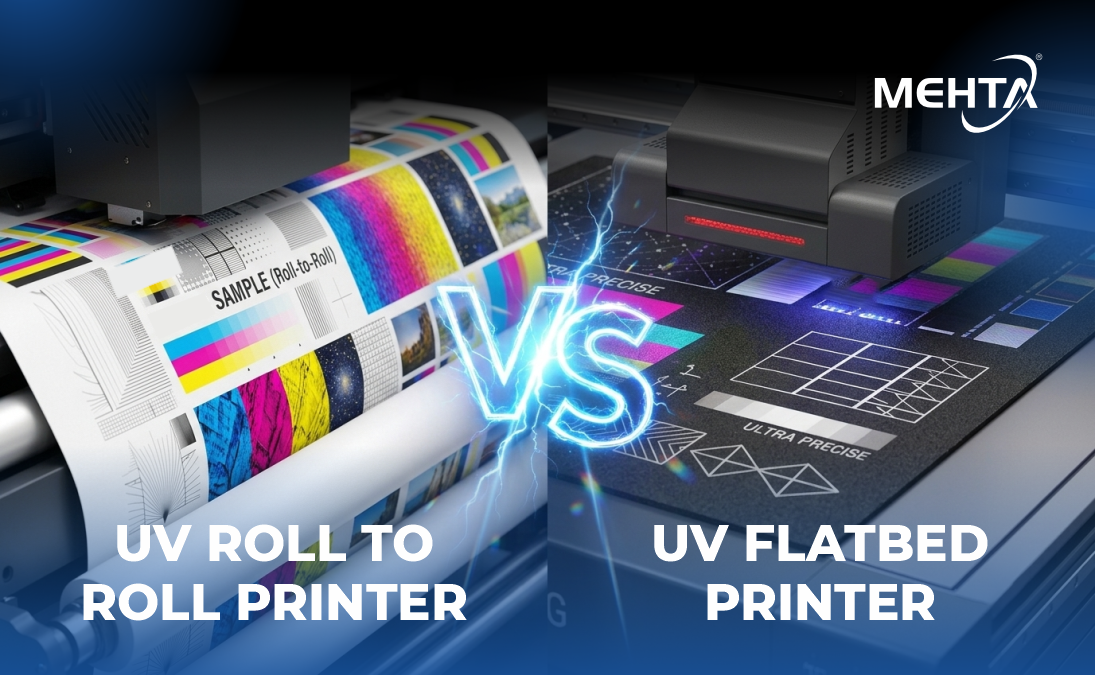
Starting or expanding a print business almost always leads to the same crossroads: should you invest in a UV flatbed printer or a UV roll to roll printer first? Both machines use UV-curable ink and deliver sharp, durable output, but they’re built for very different jobs. Understanding the difference between a uv flat bed printer and a uv printer machine designed for continuous roll media will save you from an expensive mistake and help you choose the right first machine for your print shop.
In this guide, we compare a flatbed digital printer against a uv roll to roll system across substrate compatibility, speed, footprint, and cost, so you can decide which uv printer is the smarter first purchase for your business.
Quick Comparison: UV Flatbed vs UV Roll-to-Roll
| Feature | UV Flatbed Printer | UV Roll-to-Roll Printer |
| Best For | Rigid substrates: acrylic, wood, MDF, glass, metal sheets | Flexible roll media: vinyl, banner, fabric, film |
| Print Surface | Fixed flat table, direct-to-substrate printing | Continuous roll fed through the printer |
| Typical Use Case | Signage boards, décor panels, packaging prototypes, promotional items | Banners, vehicle wraps, billboards, large-format graphics |
| Speed on Large Runs | Slower for long continuous jobs | Faster for high-volume, continuous roll printing |
| Material Thickness | Can print on thick, rigid media (up to 300mm on some models) | Limited to thin, flexible roll substrates |
| Machine Footprint | Larger flatbed table space required | More compact for the print width offered |
| Ideal First Buyer | Sign shops needing rigid-substrate versatility | High-volume banner and wrap printing businesses |
What Is a UV Flatbed Printer?
A UV flatbed printer often searched as uv flat bed printer, printer flatbed uv, or uv flatbed printing machine prints directly onto a fixed, flat surface. Instead of feeding material through rollers, the substrate sits on a stationary table while the print head moves across it, curing ink instantly with UV light. This makes a flatbed digital printer the go-to choice for rigid materials.
Where a UV Flatbed Printer Excels
- Printing directly on rigid substrates like acrylic, wood, MDF, glass, and metal sheets
- Short-run signage, décor panels, and promotional items that need a durable, one-off print
- Businesses searching for uv printing near me that require thick-media printing, sometimes up to 300mm in Z-axis height on industrial models
- Applications needing multi-layer printing CMYK plus white and varnish directly on the finished product
- Sign shops that want a single uv printer machine capable of handling packaging prototypes as well as rigid signage boards
What Is a UV Roll-to-Roll Printer?
A UV roll to roll printer feeds a continuous roll of flexible material such as vinyl, banner fabric, or film through the printer, curing the ink as it passes under UV lamps. This is the standard choice for businesses that print high volumes of uv roll to roll graphics like banners, vehicle wraps, and large-format billboards.
Where a UV Roll-to-Roll Printer Excels
- High-volume, continuous production of banners, wraps, and flexible large-format graphics
- Faster overall throughput on long print runs compared to a flatbed table
- A smaller machine footprint relative to the print width it offers, ideal for space-constrained shops
- Businesses that need consistent, repeatable output on the same flexible substrate day after day
- Buyers comparing uv roll to roll printer price against ongoing production volume, since roll-fed systems are efficient for long jobs
UV Flatbed vs Roll-to-Roll: Key Differences That Matter
1. Substrate Flexibility
This is the single biggest deciding factor. A uv flatbed printer can print on virtually anything rigid or semi-rigid, while a uv roll to roll printer is restricted to flexible roll media. If your orders vary between acrylic panels, wood signage, and banners, a flatbed offers far more versatility for a growing print business.
2. Production Speed and Volume
For businesses that print the same flexible material repeatedly at high volume think large-format billboards or vehicle wraps a roll-to-roll system generally moves faster per square foot than a flatbed table. A large format uv printer configured for roll feeding is built for exactly this kind of continuous throughput.
3. Footprint and Setup
A large format flatbed printer needs enough floor space for its full table size, since the substrate never moves during printing. Roll-to-roll systems, by contrast, can often deliver a wider effective print width in a smaller physical footprint, since the media rolls through rather than sitting flat.
4. Cost and ROI
Buyers researching uv roll to roll printer price versus flatbed pricing will find that costs vary widely by print head technology, resolution, and bed or roll size. A uv printer machine with industrial-grade heads (like Ricoh Gen 5/6 or Epson variable-dot heads) costs more upfront but delivers sharper detail and higher productivity — an important factor for any serious industrial uv printer investment.
Which Should You Buy First?
Ask yourself these questions before deciding on your first uv printer:
- What do your customers order most? If most jobs are rigid signage, packaging mockups, or décor items, start with a uv flatbed printer. If most jobs are banners, wraps, or flexible graphics, start with a uv roll to roll printer.
- Do you need one machine to do it all? Some businesses opt for a hybrid printer that handles both rigid and roll media on a single platform a smart middle path if your order mix is unpredictable.
- What’s your available floor space? Flatbed tables need dedicated room; roll-to-roll systems are often more space-efficient for the print width delivered.
- What’s your production volume target? High-volume, repeat-substrate businesses benefit more from roll-to-roll speed; low-to-mid volume, high-variety shops benefit more from flatbed versatility.
A cheapest cnc machine or second hand cnc machine may work for a hobbyist just exploring cnc router machine capabilities, but industrial buyers in wood, aluminium, stone, or signage should prioritize durability and after-sales support over the lowest sticker price.
Final Thoughts
There’s no universal answer to UV flatbed printer versus UV roll to roll printer the right first purchase depends on what your customers actually order. If rigid signage, décor, and packaging drive your revenue, a flatbed gives you far more material versatility. If your business runs on banners, vehicle wraps, and continuous flexible graphics, a roll-to-roll system will deliver better throughput and ROI.
Choosing the right manufacturer matters as much as choosing the right machine type. Mehta Hitech Industries Limited (formerly Mehta Cad Cam Systems) has over 25 years of manufacturing experience and offers dedicated UV printing solutions for both paths:
- For rigid-substrate printing, explore Mehta’s UV Flatbed Printers, available with Ricoh Gen 5/Gen 6 and Epson I3200/T3200 printheads across bed sizes up to 2500mm x 1300mm.
- For continuous roll production, explore Mehta’s UV Roll-to-Roll Printers, offering printing widths up to 3200mm and speeds up to approximately 855 sq. ft/hr.
- For businesses that need both, explore Mehta’s UV Hybrid Printers with Roll-to-Roll Attachment, built to handle rigid and roll media on a single machine.
With 15 ISO-certified manufacturing facilities, 17 sales and service offices across India, and 1,500+ professionals supporting installation and after-sales service, Mehta India can help you choose the right UV printer for your exact product mix and budget. Contact Mehta India today for a demo or a custom quote.
Frequently Asked Questions
Can a UV flatbed printer also print on roll media?
Some flatbed models offer optional roll-to-roll attachments, turning them into hybrid printers, though a dedicated roll-to-roll machine will typically run flexible media faster.
Which is cheaper to start with, flatbed or roll-to-roll?
Pricing depends more on print head technology and resolution than on flatbed versus roll-to-roll format, so compare specific models rather than assuming one category is universally cheaper.
Is a UV printer better than a solvent or eco-solvent printer?
UV printers cure ink instantly with UV light, offering faster turnaround and printing on a wider range of rigid and flexible substrates, while solvent printers are typically limited to flexible roll media.
What print heads should I look for in an industrial UV printer?
Industrial-grade heads such as Ricoh Gen 5/Gen 6 or Epson I3200/T3200 series deliver higher resolution and more reliable long-term performance for commercial production environments.
Call: +91 75750 09654
Email: mktg@mehtaindia.com
Disclaimer: The information provided in this blog, including all content and materials of any kind, is intended for informational purposes only.